
[Image source: Pexel]
If you are a student right now, you are living through one of the biggest shifts in education history. Artificial Intelligence (AI) has completely changed how we study, write, and research. Gone are the days of staring blankly at a textbook for hours; today, you have access to virtual tutors available in your pocket 24/7.
But if you have ever used a standard AI chatbot to help you write an essay or solve a complex math problem, you may have run into a very dangerous issue: AI sometimes lies.
In the technology world, this is called an “AI hallucination.” Because large language models are designed to predict words rather than act as encyclopedias, they will sometimes confidently invent fake historical dates, create non-existent book titles, or completely botch an algebra equation. If you copy and paste a hallucinated answer into your homework, your grades will suffer, and you could face serious consequences from your school for academic dishonesty.
You are encouraged to utilize these tools with caution by consistently verifying any information provided by artificial intelligence. While these models serve as powerful study assistants, your own critical thinking and human judgment must always remain the ultimate authority.
The Short Answer (TL;DR): If you want the most accurate, free AI tools for school, the best options include Google Gemini for built-in fact-checking, Perplexity AI for cited research, Wolfram Alpha for mathematically proven answers, Consensus for academic science papers, and Claude for reading heavy documents. When combined with ChatGPT for interactive tutoring and Grammarly for proofreading, students have a complete, safe, and credible homework toolkit.
Whether you are struggling with a tricky calculus problem, writing a history essay, or trying to understand a dense science chapter.
Here is a complete breakdown of the 7 best free AI tools for homework that actually give accurate answers.
[Image Source: Gemini]
1. Google Gemini: The Best AI for Fact-Checking and Brainstorming
Google Gemini is one of the most powerful and accessible AI assistants available today. Because it is built directly into Google’s massive search ecosystem, it has real-time access to the live internet. This gives it a massive advantage over chatbots that rely only on outdated training data.
- Why it is accurate and credible: Gemini’s absolute superpower for students is a feature designed specifically to fight AI hallucinations. At the bottom of its responses, you will see a small “G” logo (the “Double-check response” button). When you click it, Gemini actively searches Google to verify its own text. It highlights scientifically or historically proven facts in green (with clickable links to the real source website) and highlights questionable, unverified statements in orange. It essentially acts as its own built-in lie detector.
- How to use it for homework: Gemini is perfect for brainstorming essay topics, summarizing class notes, and researching current events. Because it connects to Google Workspace, you can export Gemini’s answers directly into a Google Doc with one click.
- Example Prompt to Try: “I have to write an essay on the causes of the American Civil War. Can you give me an outline with three main talking points?” (Once it answers, click the ‘G’ button to instantly verify the historical facts).
[Image Source: 1000Logo]
2. Perplexity AI: The Best AI for Essays and Cited Research
If you are writing a history, English, or social studies paper, standard chatbots can be dangerous because they rarely tell you where they got their information. If your teacher requires a bibliography, you need Perplexity AI. It operates as an “Answer Engine” rather than a traditional chatbot.
- Why it is accurate and credible: Perplexity does not just guess the answer from its internal memory. Instead, it searches the live internet, reads multiple credible websites in real-time, and writes a summary based only on those sites. Most importantly, it includes inline, clickable footnote citations (like [1], [2], [3]) at the end of every sentence. You can trace every single fact back to a real, credible website like PBS, National Geographic, or university pages.
- How to use it for homework: Use Perplexity to gather research, find primary sources, and build a rock-solid works cited page.
- Example Prompt to Try: “What are the environmental impacts of fast fashion on global water pollution? Please provide recent statistics and cite credible sources.”
[Image Source: WolframAlpha]
3. Wolfram Alpha: The Best AI for STEM and Guaranteed Math
Language models (like ChatGPT or Gemini) work by predicting the next word in a sentence. They do not actually “do math,” which is why they often fail at basic algebra. Wolfram Alpha is entirely different. It is a computational knowledge engine used by scientists, engineers, and university students worldwide.
- Why it is accurate and credible: Wolfram Alpha does not use language prediction; it uses hard algorithms, code, and curated databases. It does not guess—it calculates. It has been the gold standard for STEM students for over a decade because its answers are rooted in absolute mathematical rules.
- How to use it for homework: It is the ultimate tool for Algebra, Calculus, Physics, Chemistry, and Geometry. Instead of typing a conversational prompt, just type in the math equation you are struggling with. Wolfram Alpha will give you the precise, mathematically proven answer, as well as interactive graphs. (Note: Getting the exact final answer is free, though unlocking step-by-step solutions requires a premium subscription).

[Image Source: Claude]
4. Claude (by Anthropic): The Best AI for Reading Long Documents
Created by Anthropic—a company founded by researchers who wanted to focus heavily on AI safety—Claude is widely considered one of the smartest and most reliable AI models available.
- Why it is accurate and credible: Independent tech tests consistently show that Claude has one of the lowest hallucination rates of any major AI. It is highly programmed to say “I don’t know” rather than making up a fake answer. Furthermore, its free tier allows you to upload heavy documents (like long PDFs, book chapters, or massive study guides). It has an incredible memory, meaning it won’t forget what was on page 2 by the time it reaches page 50.
- How to use it for homework: Claude is your digital reading assistant. Instead of reading a 40-page PDF and feeling lost, you can upload it to Claude and ask it to break the text down for you based only on the document you provided.
- Example Prompt to Try: (Upload your history reading) “I am having trouble understanding this chapter. Can you summarize the main conflict between the two historical figures mentioned in this document in simple terms?”
[Image Source: Consensus]
5. Consensus: The Best AI for High-Level Science & College Prep
Sometimes, high school teachers or college professors will require you to use “peer-reviewed sources.” This means you cannot cite Wikipedia or random blogs; you have to cite actual published academics. Finding these studies can take hours on Google, but Consensus does it in seconds.
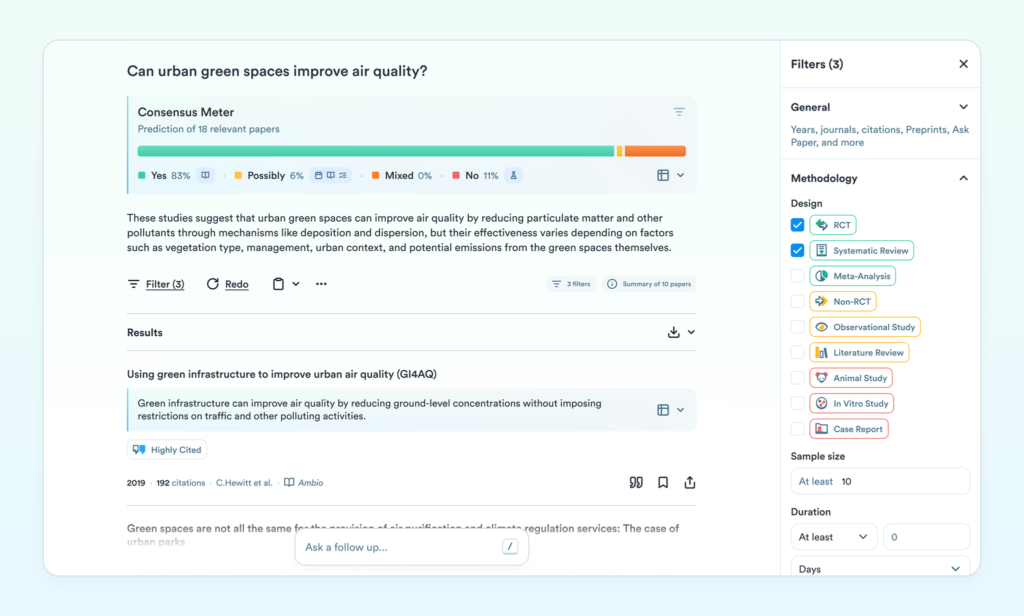
- Why it is accurate and credible: Consensus is an AI search engine built specifically for academia. It does not search the open web. It only searches a private database of over 200 million peer-reviewed, published scientific papers. If Consensus gives you an answer, it is backed by actual credentialed scientists.
- How to use it for homework: It is perfect for science fair projects, AP Capstone research, psychology papers, and debates. Ask it a direct yes or no question, and it will give you a “Consensus Meter” showing what the majority of scientists believe, along with direct links to the studies.
- Example Prompt to Try: “Does a lack of sleep directly affect the test scores of high school students?”
[Image Source: OpenAI]
6. ChatGPT (Free Version): The Best AI for Conversational Tutoring
ChatGPT, created by OpenAI, is the tool that started the modern AI boom. The free tier currently gives users access to OpenAI’s advanced models (like GPT-4o mini), which are incredibly smart, logical, and highly conversational.
- Why it is accurate and credible: OpenAI’s models have consistently passed the hardest standardized tests in the world, including AP exams, the SATs, and the Bar Exam, proving their incredibly high level of logical reasoning. While you should still verify factual claims, its ability to process complex logic and follow instructions is unmatched.
- How to use it for homework: Do not ask ChatGPT to write your essay. Instead, use it as a 24/7 personal tutor. It is incredible at practicing foreign languages, debugging broken computer code (Python, Java, HTML), and breaking down complex concepts using fun analogies.
- Example Prompt to Try: “Act as a high school biology teacher. Explain cellular respiration to me step-by-step as if I am 12 years old. Then, ask me a 3-question multiple-choice quiz to see if I understood it.”
[Image Source: Grammarly]
7. Grammarly (Free Version): The Best AI for Final Proofreading
Once your research is done and your essay is written, you want to make sure you don’t lose silly points for bad punctuation, run-on sentences, or poor formatting. Grammarly has been using AI to fix student writing for years, long before modern chatbots became popular.
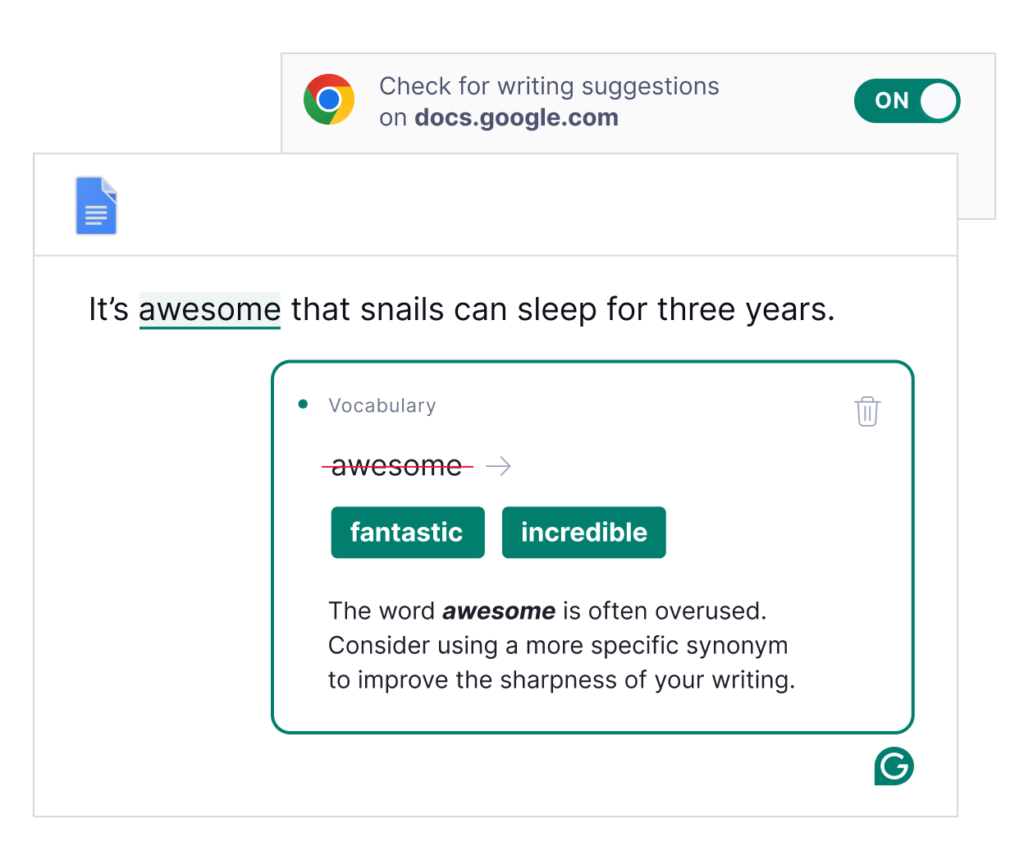
- Why it is accurate and credible: Grammarly uses highly tuned, rule-based algorithms to check your writing against the strict rules of the English language. It is incredibly accurate at catching comma splices, spelling errors, and awkward phrasing.
- How to use it for homework: Run your final essays, lab reports, or even emails to your teachers through Grammarly’s free version. Most importantly, because Grammarly doesn’t generate new ideas or write the essay for you, it is fully accepted by almost all school academic integrity policies.
The 3 Golden Rules: How to Use AI Without Cheating
Having these incredible, accurate tools at your fingertips is a superpower. However, if you use AI the wrong way, you cross the line from studying to cheating. To protect your academic integrity and actually learn the material, you must follow these three rules:
1. Never Copy and Paste AI Text
Never ask an AI to write an essay or solve a math problem, and then copy the final answer directly into your homework. Teachers have access to sophisticated AI detectors (like Turnitin and GPTZero). Submitting AI-generated work is considered plagiarism. Use AI to outline, brainstorm, and research, but write the final words with your own brain and your own fingers.
2. Use AI as a Tutor, Not a Ghostwriter
If you let the computer do all the thinking, you will inevitably fail your final exam when you don’t have access to your phone. Change the way you ask questions. Instead of saying, “Write a paragraph about George Washington,” say, “I am writing a paragraph about George Washington. Can you review my draft and tell me how to make it better?” Use it to guide you, not replace you.
3. Always Trust, But Verify
Even the most accurate AI on earth can occasionally make a mistake. If an AI gives you a crucial date, a specific statistic, or a quote for an essay, always double-check it. Click the footnote links in Perplexity, use Gemini’s “G” button, or look in your class textbook to guarantee the information is correct before turning it in.
Artificial intelligence is the ultimate study buddy, and knowing how to use it correctly is a skill that will help you in high school, college, and your future career. By relying on credible tools and avoiding basic chatbots that make things up, you can cut your homework time in half, deeply understand complex topics, and keep your grades perfectly safe.
Disclaimer:
This article was drafted with the assistance of AI technology and reviewed by a human author for accuracy, clarity, and tone.