
Author: River [Image Source: Elementor]
Back in 2017, when Google’s AlphaGo beat world champion Ke Jie at the ancient game of Go, it sent shockwaves around the world. For many, it was the first real glimpse of artificial intelligence flexing its mental muscles, proof that machines could outthink even the best human minds. The victory sparked endless debates: could AI truly “think”? Was it on track to rival human intelligence?
The symbolism couldn’t be clearer: AI has leapt out of the screen and into the real world, embodied in machines that don’t just calculate, but move, sweat, and endure in ways once reserved for humans. And this wasn’t simply a headline-grabbing stunt. It marked a tipping point. Humanoid robots are no longer confined to labs or trade shows; they’re beginning to appear in the same spaces we live, work, and play. That marathon in Beijing wasn’t just a test of endurance. It was a glimpse into the future, one where these machines could transform industries, reshape economies, and become part of our everyday lives.
More Than Machines: Human-Like Partners at Work
Humanoid robots are not just machines dressed with human features. They are complex systems that replicate human form and function, allowing them to operate in environments designed for us. Powered by advances in machine learning, robotics, and adaptive algorithms, they can perceive, reason, and act with a surprising level of autonomy.
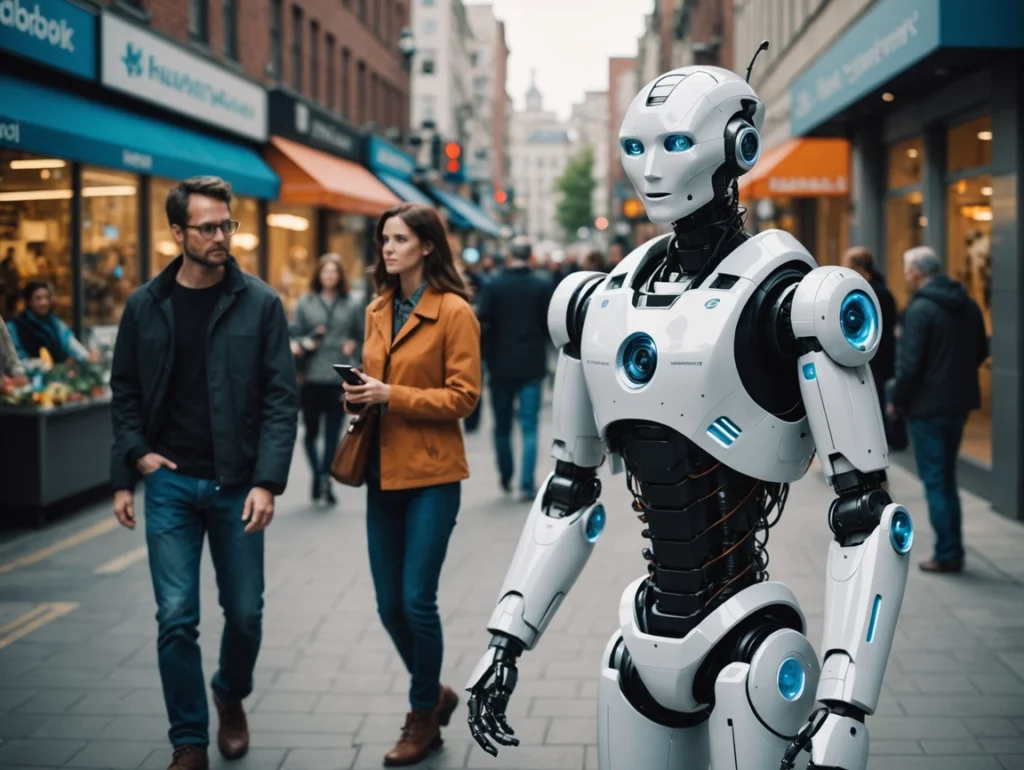
Unlike traditional factory robots locked in safety cages, humanoids are built to collaborate. Picture a robot nurse lifting patients, a shop assistant guiding customers through a mall, or a delivery bot climbing flights of stairs. Their ability to adapt to human spaces means they could fill roles that are currently underserved or unsafe. And with modern AI, they are learning new tasks in weeks, not years.
The implications are staggering. Analysts predict billions could be in use by 2040. Humanoid robots are beginning to take on roles across a wide range of fields. In healthcare, they can support elderly care, assist with diagnostics, and even handle minor medical procedures. In retail and service industries, they’re stepping in to guide customers, restock shelves, and strengthen security. Within cities and public spaces, these machines are being designed to manage cleaning, maintenance, and even aspects of community policing. And in more personal settings, they’re emerging as companions, assistants, and even educators. Together, these applications signal more than just convenience. They point to a fundamental shift in how work is carried out across entire sectors.
A Global Race for Leadership
The humanoid robotics boom is inseparable from the global AI race. Today, two frontrunners dominate: the United States and China. Together, they control most of the intellectual property, foundational models, and hardware advances underpinning humanoid systems. Stanford’s AI Index reports that 83% of AI patents come from these two countries, leaving Europe and others trailing behind.
China’s growth is especially striking. Its humanoid robotics market is projected to surge from RMB 2.76 billion ($377 million) in 2024 to RMB 75 billion ($10.3 billion) by 2029, capturing nearly one-third of the global market in just five years. Government subsidies, infrastructure spending, and national strategies have accelerated this rise. Patent filings reinforce the trend: China logged 5,688 humanoid robotics patents in the last five years nearly four times more than the US.
Meanwhile, Japan and South Korea are leveraging their robotics heritage to position themselves in healthcare and service robots, while Europe focuses on regulation and ethical frameworks. Yet the Beijing marathon made one point crystal clear: China is no longer following. It is setting the pace in a trillion-yuan race.
What This Means for Work and Society
For many, robots trigger anxieties about job loss. And yes, displacement is real. But the larger story is about transformation rather than elimination. In dangerous fields like mining, firefighting, or disaster response, humanoids could save lives by taking humans out of harm’s way. In aging societies from Japan and South Korea to Germany and China robots may help solve looming shortages in elder care and healthcare.
Instead of erasing jobs, humanoid robots could shift their nature. They can take over hazardous, repetitive, or physically draining tasks, allowing humans to focus on creative, interpersonal, or high-value work. New roles will also emerge: training robots, designing collaboration systems, overseeing ethical use, and ensuring safety. For companies, the benefits go beyond cost savings. Robots can enhance customer experience, deliver consistent quality, and open up entirely new services. Imagine humanoids serving as airport guides, classroom tutors, or construction site safety monitors.
Collaboration, Not Replacement
The future of robotics is not about replacing people. It’s about collaboration. Amazon offers an early glimpse. Today, it employs over 750,000 robots in its warehouses not humanoids, but integrated machines working seamlessly with human staff. The company is now testing humanoids for last-mile deliveries, pairing them with drivers to manage multiple addresses. The company is also building a “humanoid park” in the US to test the robots, and there’s no human person who had been involved in the project. The goal isn’t to eliminate people, but to see whether humanoids can handle the messy complexity of the real world in partnership with humans. This hybrid future of humans and robots working side by side may well define the next era. And it highlights why human skills like communication, empathy, and ethics will remain critical.
A Choice We Must Make
Humanoid robots are no longer confined to science fiction. They are here and multiplying. Within a decade, they may shift from novelty to everyday presence: colleagues, assistants, companions. But this future is not predetermined. It depends on choices. Do we design robots to empower people, or to replace them? Do we allow them to deepen inequality, or to expand opportunity? Do we react with fear, or shape their role with intention?
If guided wisely, humanoid robots could become more than tools. They could be partners that help solve urgent challenges such as labour shortages, hazardous work, elder care, and beyond. They could boost productivity, enrich quality of life, and redefine human collaboration in the 21st century.
References:
“Humanoid Robots Offer Disruption and Promise”, World Economic Forum (2025) Retrieved from https://www.weforum.org/stories/2025/06/humanoid-robots-offer-disruption-and-promise/
“Amazon testing humanoid robots to deliver packages’, The Guardian (2025) Retrieved from https://www.theguardian.com/technology/2025/jun/05/amazon-testing-humanoid-robots-to-deliver-packages
“Humanoid Robots: The 16 Leading Manufacturers Shaping The Future”, Reliable Robotics (2025) Retrieved from
*Disclaimer: This article was drafted with the assistance of AI technology and then critically reviewed and edited by a human author for accuracy, clarity, and tone.