
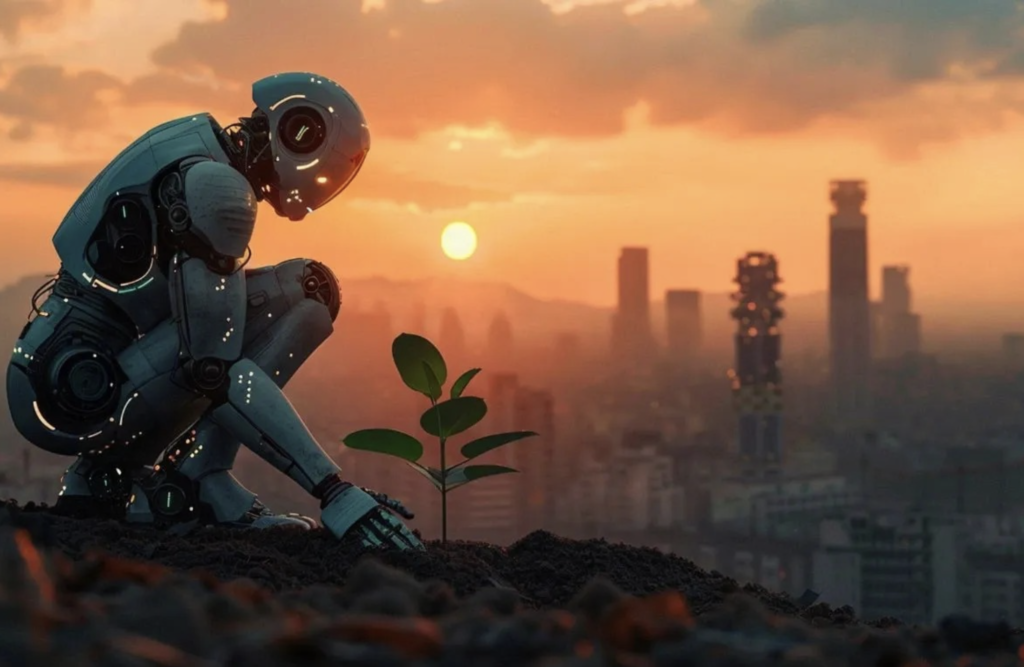
Author: River [Image Source: Forbes]
Artificial Intelligence (AI) is now the primary force behind global innovation rather than a supporting technology. AI has started to change the technological landscape in ways that were previously only seen in science fiction, from microprocessors that adjust to their surroundings to algorithms that can reason on their own. The Stanford AI Index Report 2025 estimates that over $250 billion has been invested globally in AI-driven technologies, ushering in a time when intelligent algorithms power almost every new invention, from cloud computing to robotics.
Convergence is a defining feature of modern technological advancement: AI is combining with data systems, hardware, and software to form an interconnected ecosystem where machines can learn, adapt, and develop. The age of intelligent technology has already arrived; it is not coming. AI is changing how we develop, optimize, and use technology in a variety of fields, including energy, cybersecurity, healthcare, and transportation.
The Dawn of the Intelligent Age
In the past, technology changed as a result of the electrical and mechanical revolutions; first, computers took the place of manual computation, and later, machines replaced muscle. They are now reproducing intelligence itself. AI technologies analyze data, learn on their own, and make decisions with little human intervention, in contrast to earlier advancements that only increased human capabilities.
These days, machine learning models can process more data in an hour than the human brain can in a lifetime. As a result, adaptive systems—a new class of technology—continually get better depending on their surroundings. These systems form the basis of what experts call The Intelligent Age, in which machines function as collaborators rather than merely tools.
In the automotive sector, for example, AI-powered cars employ predictive algorithms to foresee driver behavior, road conditions, and even mechanical wear. Intelligent chips in semiconductor manufacturing extend performance and sustainability by dynamically optimizing energy consumption based on usage patterns.
Computational power and data abundance have combined to accelerate AI’s development well beyond linear progression. “AI is no longer about automation it’s about augmentation, where machines and humans learn together,” according to Stanford University’s Dr. Fei-Fei Li.
AI-Powered Infrastructure: Building the Backbone of Tomorrow’s Technology
The infrastructure of contemporary technology, which includes networks, data centers, and communication systems that link billions of devices, is its unseen layer. This backbone has been subtly transformed by AI, which has made it predictive and self-optimizing.
AI is now used by cloud providers like Google Cloud, AWS, and Microsoft Azure to control cooling systems, identify network congestion, and anticipate server failures before they happen. In large-scale data centers, this predictive infrastructure has decreased energy consumption by almost 30% and downtime by up to 40%.
Through dynamic bandwidth management and intelligent spectrum allocation, artificial intelligence (AI) improves 5G networks in telecommunications, guaranteeing optimal connectivity even during peak hours. According to Ericsson’s 2025 AI Network Optimization Report, latency problems have been cut by 25% in a number of international cities thanks to AI-driven maintenance.
AI has brought about a new paradigm in energy optimization that goes beyond data management. Deep learning models enable smart grids to identify power outages, predict consumption trends, and instantly reroute energy flow. The groundwork for sustainable cities with intelligently synchronized energy, traffic, and communications is being laid by these self-healing systems.
Revolutionizing Human-Technology Interaction
People have been learning how to use technology for decades. Technology is now becoming more human-aware. People’s interactions with digital systems are changing as a result of developments in emotion recognition and natural language processing (NLP).
Humanoid robots, chatbots, and voice assistants are changing from command-based devices to sympathetic partners that can recognize intent, tone, and emotion. Businesses like DeepMind, Anthropic, and OpenAI have created multimodal models that can process speech, text, and images all at once, resulting in more organic human-machine interactions.
Wearable technology, augmented reality (AR) gadgets, and even brain-computer interfaces (BCIs) are increasingly incorporating AI systems. For example, Neuralink is at the forefront of direct neural communication, which may enable thought-based engagement with digital spaces. The shift from digital to cognitive interfaces—technology that adjusts to human thought instead of requiring humans to adjust to it—is signified by these integrations.
A future in which technology not only reacts but also anticipates is suggested by this symbiosis between human cognition and machine intelligence. Imagine virtual tutors that can sense confusion and modify their teaching strategies in real time, or gadgets that can recognize mental fatigue and change the brightness of the screen.
AI in Scientific Discovery and Innovation
Accelerating scientific discovery is one of AI’s most significant effects. By finding correlations, coming up with hypotheses, and even creating experiments on its own, artificial intelligence (AI) shortens the cycle of years of experimentation that traditional research methods frequently require.
Drug discovery was revolutionized when DeepMind’s AlphaFold solved a fifty-year biological puzzle by accurately predicting protein structures. In a similar vein, IBM’s Project Debater demonstrated how AI can instantly create logical, fact-based arguments by synthesizing enormous amounts of research data.
Materials science is also changing as a result of AI-driven simulation. Machine learning models forecast the best candidates for new alloys, semiconductors, or superconductors rather than manually testing thousands of chemical combinations. R&D time and expense are significantly decreased as a result.
NASA uses artificial intelligence (AI) in space exploration to analyze astronomical data from the James Webb Space Telescope, finding exoplanets and other celestial objects that human researchers might miss. The result is an exponential increase in the rate of discovery in chemistry, biology, and physics.
The Rise of Autonomous Systems
AI is powering the next wave of automation, from manufacturing robots that can learn new tasks on their own to drones that can navigate disaster areas. These systems don’t need pre-programmed instructions anymore; instead, they learn and adapt in real time.
Reinforcement learning is integrated into modern robotics, allowing machines to learn from experience in a manner similar to that of humans. Thanks to computer vision and adaptive feedback systems, Boston Dynamics’ robots can now execute intricate tasks like parkour and warehouse operations with amazing accuracy.
By using AI to forecast package flows, optimize routes, and manage robotic fleets, logistics companies such as Amazon and DHL are able to achieve operational efficiency levels that were previously thought to be unattainable. Autonomous drones in agriculture minimize waste and increase yield by tracking crop health, identifying pest outbreaks, and even delivering targeted treatments.
These developments show how automation is giving way to autonomy, where systems see, make decisions, and act on their own. This is changing industries from manufacturing to urban mobility.
Ethics, Trust, and the Responsible Use of Intelligence
Concerns about ethics become more pressing as AI permeates every aspect of technology. Both societal and regulatory challenges arise from issues like algorithmic bias, data privacy, and autonomous decision-making.
The 2025 Global AI Governance Report from the World Economic Forum highlights the necessity of accountable systems and transparent algorithms. In order to guarantee responsible AI use, governments are currently creating frameworks that strike a balance between innovation and privacy, equity, and safety.
Prominent tech firms have established AI ethics committees to examine data procedures and decision-making results. In order to solve the “black box” issue that has long dogged AI systems, methods like explainable AI (XAI) are being used to make algorithmic decisions understandable by humans.
The Future of AI-Driven Technology
More than 80% of all new digital technologies are expected to be powered by AI by 2030. By allowing devices to process data locally, edge AI will lower latency and energy usage. Education, engineering, and medical fields will be dominated by hybrid intelligence systems, in which artificial intelligence works in tandem with human specialists.
As AI combines with blockchain, quantum computing, and augmented and virtual reality, the lines separating the digital and physical worlds will become increasingly hazy. According to Gartner, “AI will evolve from a tool of automation to a medium of innovation,” paving the way for self-designing technologies. As we approach this new era, the question is not if artificial intelligence will change the nature of technology in the future, but rather to what extent it will change the definition of technology.
References:
[1] Stanford AI Index Report (2025). “AI and the Global Technology Landscape.” Retrieved from https://aiindex.stanford.edu
[2] Wired Tech Review (2025). “The Intelligent Age: How Machines Learn and Evolve.”
[3] MIT Media Lab (2025). “Human-AI Interfaces: From Commands to Understanding.”
[4] World Economic Forum (2025). “Responsible AI Governance in the Digital Age.”
[5] Gartner (2025). “Emerging Technologies Forecast 2030.”
Disclaimer: This article was drafted with the assistance of AI technology and then critically reviewed and edited by a human author for accuracy, clarity, and tone.