
Author: River [Image Source: Pavel Danilyuk/Pexels ]
From a specialized area of study, artificial intelligence (AI) has developed into a disruptive force that influences how contemporary companies function, compete, and expand. To make important decisions in the past, businesses mainly relied on manual analysis, human intuition, and sparse data. However, AI now enables businesses to optimize workflows, forecast future events with remarkable accuracy, and transform massive volumes of data into actionable intelligence.
AI signifies a radical change in how companies view value creation, not just another technical advancement. Artificial intelligence (AI) technologies like machine learning, natural language processing (NLP), and computer vision are transforming every industry sector, from automating repetitive tasks to facilitating strategic foresight. Businesses that previously found it difficult to adapt to changes in the market are now using AI to predict trends, customize services, and improve decision-making with accuracy.
This revolution is cultural in nature rather than merely technological. Companies are learning how to incorporate AI into their long-term goals, decision-making processes, and workflows. Early adopters of AI are establishing the norms for the digital economy, while those who don’t run the risk of falling behind.
Redefining Decision-Making Through Data Intelligence
Decisions are no longer made solely on the basis of intuition or experience in the contemporary business world. Rather, the new basis for decision-making is data-driven intelligence. Businesses can process and interpret large datasets in ways that are far beyond human capabilities thanks to artificial intelligence.
AI finds correlations and patterns that would otherwise go overlooked by using machine learning algorithms and advanced analytics. AI systems, for example, are able to analyze millions of transactions in order to identify fraudulent activity, predict changes in the market, or anticipate customer attrition before it occurs. By transforming raw data into foresight, this predictive capability gives businesses a competitive edge.
AI-powered decision-making also reduces human prejudice. AI is based on evidence and probability, whereas humans may rely on instinct. This change enables businesses to make data-driven, rather than speculative, strategic decisions in industries like finance, healthcare, and logistics. Businesses are able to make decisions more quickly, accurately, and confidently as a result, opening the door for more intelligent corporate governance.
Automating Operations for Maximum Efficiency
Automation is one of the most obvious effects of AI in business. Intelligent systems can now perform repetitive, time-consuming tasks with little supervision that previously required large teams. Businesses are reaching previously unthinkable levels of efficiency through AI-driven process optimization and robotic process automation (RPA).
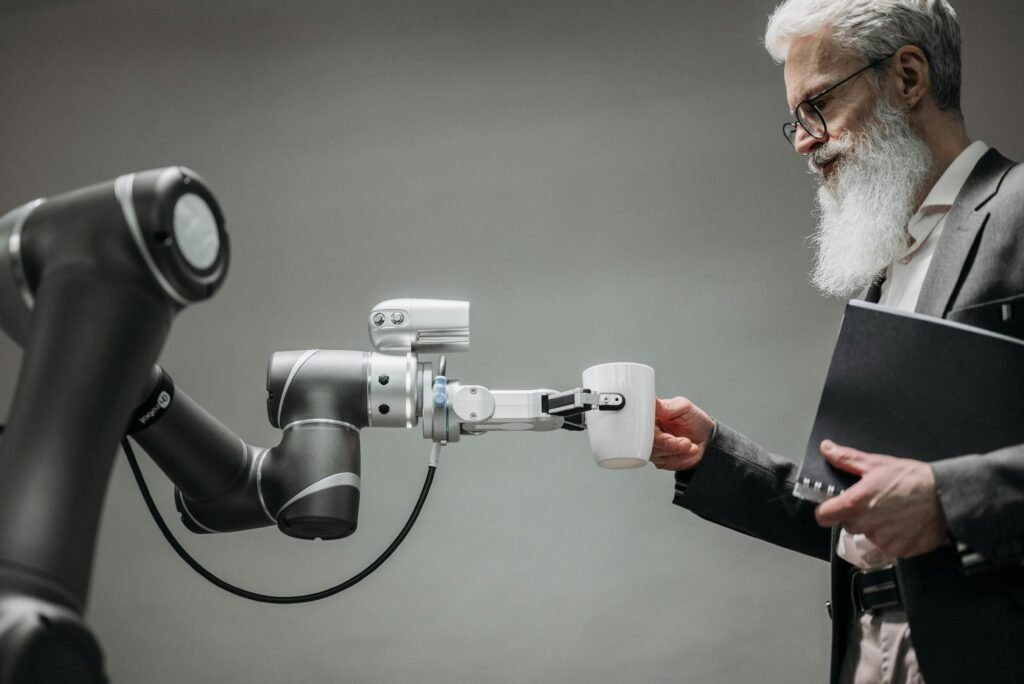
AI-powered robots coexist peacefully with human operators in manufacturing. In order to find inefficiencies, find flaws, and even anticipate maintenance requirements before malfunctions happen, these robots evaluate production line data in real time. This predictive maintenance feature prolongs the life of machinery and avoids expensive downtime.
AI manages intricate administrative duties like processing invoices, onboarding new hires, and managing customer support tickets. Because chatbots and virtual assistants are always available, businesses can maintain consistent service without having to hire more workers. Beyond financial savings, automation allows workers to concentrate on strategic thinking, innovation, and creativity instead of tedious manual labor.
Businesses that implement intelligent automation report productivity gains of up to 30% in the first year, per Deloitte’s research. The true potential of AI is not to replace people, but to enhance their abilities and foster a cooperative environment where people and technology work together to accomplish more.
Improving the Client Experience with Customization
The customer is genuinely at the heart of every business strategy in the fiercely competitive market of today. AI is essential for comprehending consumer behavior and tailoring each person’s experience.
AI can anticipate what customers want—often before they express it—by examining browsing habits, past purchases, and even emotional reactions. AI-powered recommendation systems have been the foundation of the success of websites like Amazon, Spotify, and Netflix. By continuously refining their recommendations to perfectly suit user preferences, these systems learn from each user’s behavior.
AI is also revolutionizing real-time customer interactions for businesses. Natural language processing (NLP) is used by virtual assistants like ChatGPT, Alexa, and Google Assistant to comprehend and react to human inquiries. By providing prompt, reliable, and sympathetic answers to millions of questions every day, this human-like interaction increases user satisfaction.
Additionally, sentiment analysis powered by AI enables businesses to track consumer opinions about their goods and services on social media. Businesses can better handle complaints, forge closer bonds with customers, and preserve a positive brand image by examining feedback and emotional tone.
Hyper-personalization, in which each message, product recommendation, and interaction feels tailored to the individual user, is the way of the future for customer engagement. This vision is made possible by AI.
Predictive Analytics and Market Foresight
One of the most potent uses of AI is predictive analytics, which gives companies the ability to predict future trends with amazing accuracy. Artificial intelligence (AI) models can predict demand, consumer behavior, and even possible market disruptions by evaluating both historical and current data.
AI in retail helps businesses optimize inventory levels and prevent shortages or overstock by forecasting which products will sell during different seasons. Predictive algorithms in logistics assess weather, delivery routes, and traffic data to guarantee quicker and more effective shipments.
Financial institutions can now forecast market volatility and suggest the best investment plans thanks to AI. Predictive analytics in healthcare can foresee patient risks or disease outbreaks, enabling quicker interventions.
Predictive analytics is revolutionary because it is not only accurate but also flexible. Over time, AI models improve their predictions by continuously learning from new data. Businesses gain a growing understanding of the market thanks to this dynamic learning loop, which keeps them competitive and flexible. Businesses that use AI-based forecasting tools have a 25% higher chance of outperforming their peers in terms of revenue growth and customer retention, according to Gartner.
Reinventing Business Models and Innovation
Artificial intelligence is changing the definition of businesses, not just how they operate. AI innovation is giving rise to completely new business models that are changing established industries and generating new revenue streams.
For instance, “as-a-service” has become more than just software. Predictive maintenance-as-a-service, in which AI tracks equipment performance and proactively schedules repairs, is now available from manufacturers. Financial institutions democratize access to financial planning by using AI-powered robo-advisors to provide reasonably priced investment advice.
Research and development (R&D) is also accelerated by AI. Previously taking years, AI-driven drug discovery platforms in the pharmaceutical industry can now simulate millions of molecular combinations in a matter of days. Artificial intelligence (AI) tools are used in product design to evaluate consumer input, forecast market responses, and create prototypes with enhanced usability and appeal.
AI-driven innovation extends beyond products to strategy. Generative AI is used by businesses to test marketing campaigns, generate ideas, and even develop new branding concepts. A new era of intelligent innovation has begun with this degree of creative human-machine collaboration.
Challenges and Ethical Considerations
Even though AI has a lot to offer, there are also big problems that companies need to properly handle. The three most urgent issues are workforce displacement, algorithmic bias, and data privacy.
Artificial intelligence (AI) systems learn from data, but if that data contains bias, the algorithms may inadvertently reinforce discrimination in customer service, lending, or employment. Therefore, it is crucial that AI decision-making be transparent and equitable. Businesses need to put in place ethical frameworks that guarantee equity, explainability, and accountability in AI results.
Another important issue is data privacy. Companies that gather a lot of user data need to protect it from abuse and breaches. Companies must handle data with strict confidentiality in order to comply with regulations like the GDPR in Europe and similar laws around the world.
It’s also reasonable to worry about losing your job to automation. Employees must adjust to new roles requiring digital literacy, creativity, and strategic thinking as AI automates repetitive tasks. In order to prepare their employees for the AI-driven future, forward-thinking businesses are investing in reskilling and upskilling initiatives. In the end, ethical AI is essential to long-term digital transformation and cannot be ignored.
The Future of AI in Business
AI will keep changing in the future, moving from a technological benefit to a strategic requirement. AI will be incorporated into every operational layer by companies in every industry, including retail, real estate, healthcare, and hospitality.
These changes will be accelerated by new technologies like edge AI, quantum computing, and generative artificial intelligence. By creating code, product designs, and marketing content, generative AI will transform the creative industries. Businesses will be able to solve issues that are currently thought to be intractable thanks to quantum AI’s exponential increase in processing power. Edge AI will improve speed, security, and scalability by bringing real-time decision-making closer to data sources.
Businesses that see AI as a partner—a collaborator that boosts human potential, creativity, and vision—rather than merely a tool will be the ones that thrive in this new era. The businesses that adopt this synergy will shape the next wave of international business.
References
-
- Harvard Business Review – How AI Is Changing Business Decision-Making
- Harvard Business Review – How AI Is Changing Business Decision-Making
-
- McKinsey & Company – The State of AI in 2025
- McKinsey & Company – The State of AI in 2025
-
- Deloitte Insights – Intelligent Automation: The Next Frontier
- Deloitte Insights – Intelligent Automation: The Next Frontier
-
- Salesforce Research – AI and the Customer Experience
- Salesforce Research – AI and the Customer Experience
-
- Gartner Research – Predictive Analytics in Business Strategy
- Gartner Research – Predictive Analytics in Business Strategy
-
- MIT Sloan Management Review – AI and the Future of Business Innovation
- MIT Sloan Management Review – AI and the Future of Business Innovation
-
- World Economic Forum – Ethics and Governance in Artificial Intelligence
- World Economic Forum – Ethics and Governance in Artificial Intelligence
-
- Accenture Report – The Future of AI in Global Business
Disclaimer: This article was drafted with the assistance of AI technology and then critically reviewed and edited by a human author for accuracy, clarity, and tone.