Author: Fatih Azka
Every few dry seasons, the acrid scent of charred peat drifts across the Malacca Strait, blanketing Singapore in a dull, yellowish shroud. As air quality indicators plunge into unhealthy territory and pharmacies sell out of N95 masks, a familiar chorus emerges from tech corridors and policy roundtables: artificial intelligence will map, model, and mitigate the crisis.
On paper, the technocratic optimism is compelling. Machine learning algorithms digest real-time satellite imagery, atmospheric wind patterns, and ground-sensor metrics to predict transboundary smoke plumes with unprecedented precision. Computer vision models can detect hot spots in Sumatra and Kalimantan hours before human analysts spot thermal anomalies. Predictive algorithms assist city planners in dynamically regulating indoor air filtration systems across schools and MRT stations. In a nation deeply invested in the “Smart Nation” ethos, treating transboundary haze as an optimization problem feels both natural and reassuring.
Yet, this faith in algorithmic salvation mistakes an information problem for a political economy problem.
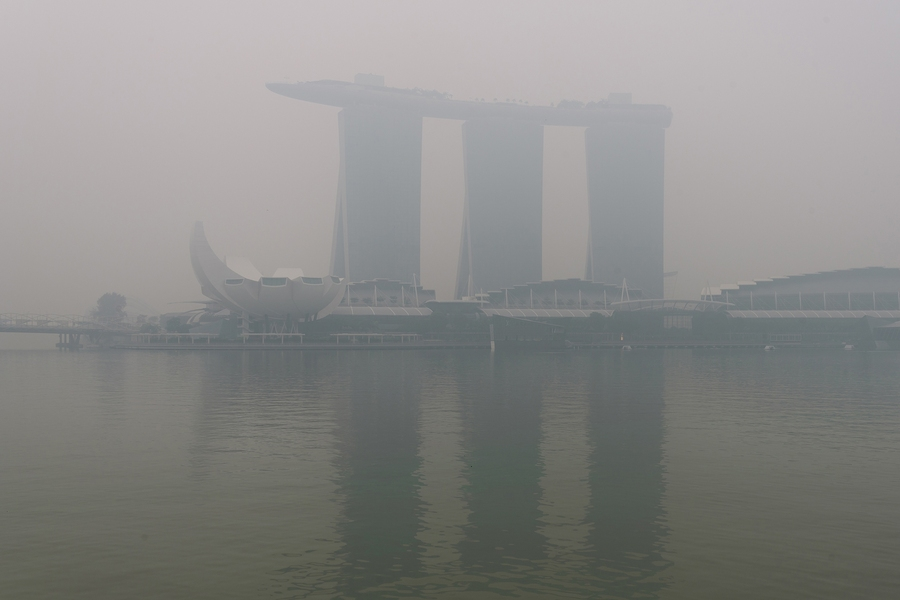
Image Source: MIT News
First, AI suffers from a fundamental illusion of agency: it confuses surveillance with control. Knowing precisely which coordinates in Riau are igniting, or forecasting with 97% accuracy that fine particulate matter ($PM_{2.5}$) will peak at noon in Bishan, does not extinguish a peat fire. Peatland blazes burn deep underground, often smoldering meters beneath the surface where water drops from firefighting aircraft vaporize before reaching the fuel. Predictive precision cannot substitute for the gritty, labor-intensive work of peat rewetting, canal blocking, and sustained ground enforcement.
Second, the techno-optimist lens depoliticizes an issue rooted in supply-chain economics and regional diplomacy. Haze is driven by slash-and-burn clearing for lucrative commodities like palm oil and pulpwood. Complex corporate webs, paper companies, and local patronage networks obscure ultimate land ownership. While AI-driven spatial tracking can highlight illegal deforestation, algorithms cannot overcome sovereign sensitivities, enforce the Transboundary Haze Pollution Act, or compel cross-border judicial cooperation within the non-interference framework of ASEAN. Knowing where the fire is does not confer the jurisdiction or the geopolitical leverage to extinguish it.
Finally, relying on algorithmic modeling risks shifting the burden from systemic eradication to passive domestic adaptation. When states celebrate predictive apps that tell citizens which hour to avoid outdoor jogs, public health becomes an individual risk-management exercise rather than an international failure of environmental regulation. It normalizes chronic ecological breakdown into a series of push notifications.AI provides an extraordinary mirror, reflecting every wind shift, burning acre, and particulate spike with clinical fidelity. But a clearer view of the smoke does not clear the air. Until regional governance, supply chain accountability, and agrarian land reform match the sophistication of Singapore’s digital models, artificial intelligence remains merely a high-tech spectator to an annual environmental failure.
Disclaimer: This article was drafted with the assistance of AI technology and then critically reviewed and edited by a human author for accuracy, clarity, and tone.
The opinions expressed in this piece are solely those of the authors and do not represent the official stance of PT. SeCreative Kita Maju. This work is made available under a Creative Commons license.
Any republication must, at a minimum:
Attribute the authors and their affiliated organizations.
Credit PT. SeCreative Kita Maju, including a direct link to either our homepage or the original article URL.