
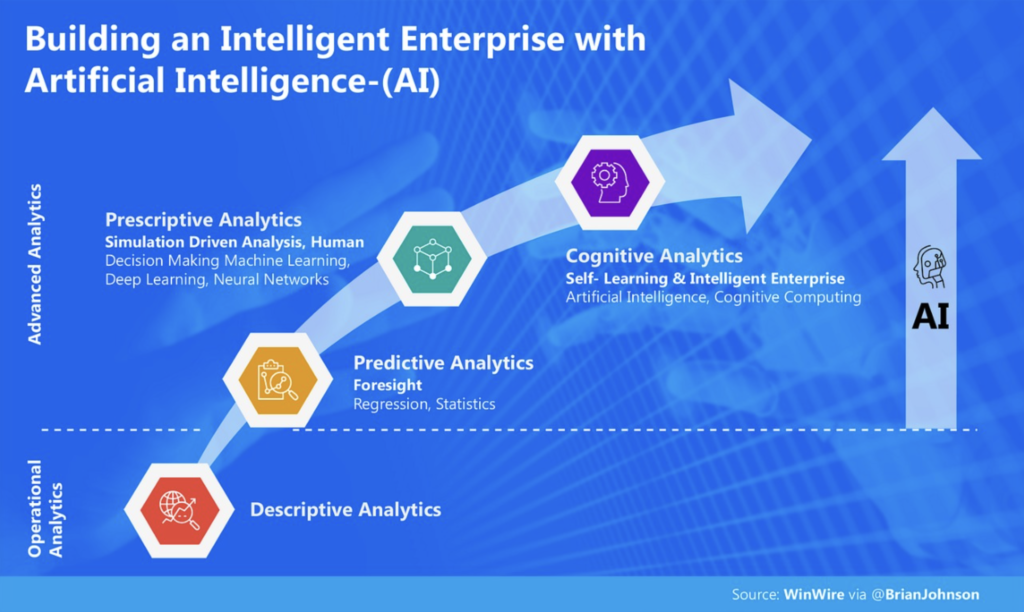
Author: River [Image Source: Medium]
When IBM’s Watson defeated human champions on the Jeopardy! quiz show in 2011, it wasn’t just a game; it was a signal. Businesses got a first look at what AI might entail outside of science fiction or academic labs. Watson’s victory was more than just a clever algorithm solving trivia questions. It signaled the start of a new era in which artificial intelligence (AI) would be able to sort through enormous amounts of data, produce insights at a rate never seen before, and provide significant benefits in decision-making.
Today’s businesses around the world are vying to become intelligent businesses, not just adopt AI. This has nothing to do with automating invoices or integrating a chatbot. It involves rethinking whole operational models where human creativity, data, and algorithms come together. AI is a key source of competitive advantage for the smart enterprise, not a supplementary tool.
Intelligence Beyond Automation: Redefining Business Models
The journey of becoming an intelligent enterprise begins with a shift in perspective. For decades, businesses have relied on technology to automate processes, cut costs, and increase efficiency. But AI has moved the conversation beyond automation. Intelligent enterprises do not see AI as a tool that merely replaces human labor. Instead, they see it as a catalyst for reimagining business models entirely. Airlines, for example, no longer just optimize ticket sales, they deploy AI to anticipate flight demand, adjust routes, and even design sustainable aviation strategies that cut emissions while boosting profitability. Retailers use AI-driven personalization engines to deliver shopping experiences so unique that customers feel they are dealing with a boutique, even when shopping in a global e-commerce marketplace. And in finance, AI is not just accelerating transactions but creating entirely new ecosystems in digital banking, where financial advice and services are delivered at scale with an intimacy that was once impossible.
This strategic use of AI transforms organizations from reactive players into predictive leaders. They no longer wait for customer behavior or market shifts to happen; they anticipate and shape them. It is this ability to forecast and innovate ahead of competitors that distinguishes intelligent enterprises from traditional ones.
The Human-AI Partnership: Empowering the Workforce
However, the story of intelligent enterprises is not about machines replacing people. On the contrary, the most successful organizations treat AI as a partner, not a rival. In law firms, AI drafts contracts and sifts through mountains of legal documents, but lawyers remain indispensable in strategy, negotiation, and judgment. Manufacturers use AI systems to predict maintenance needs and identify production anomalies, but it is human engineers who redesign processes, solve problems, and imagine future products. Even in customer service, where chatbots resolve the simplest queries, it is human agents who step in when nuance, empathy, and creative problem-solving are needed.
This partnership model is what elevates enterprises from being merely technologically advanced to being truly intelligent. By offloading routine, repetitive, and large-scale tasks to AI, human workers are freed to do what they do best: think critically, innovate, and connect with other people. Far from diminishing the workforce, the intelligent enterprise empowers it, creating a workplace where human creativity and machine precision coexist.
Building Trust and Ethics as a Core Advantage
But intelligence is not just about speed, foresight, or productivity. It is also about trust. In a world where algorithms influence decisions from hiring to healthcare, the question of whether AI is fair, transparent, and accountable becomes central. Intelligent enterprises recognize that trust is the new competitive currency. European companies are at the forefront of this shift, embedding ethical frameworks into AI deployment to ensure that systems are explainable, transparent, and free from harmful bias. Multinational corporations are forming governance boards dedicated to overseeing how AI is used within their organizations, while consumers increasingly reward businesses that openly disclose how their data is used.
For these companies, ethical AI is not merely about compliance, it is a market advantage. By showing responsibility and transparency, intelligent enterprises build loyalty among customers, attract talent, and gain credibility in industries where trust can be the difference between success and failure.
The Global Race Toward Intelligent Enterprises
The race to build intelligent enterprises is also a global competition. The United States continues to dominate in generative AI and cloud-based business solutions, driven by Silicon Valley startups and tech giants. China, however, has embedded AI into the fabric of its economy, from manufacturing hubs in Shenzhen to the e-commerce platforms of Alibaba. This integration has made AI not just a tool, but a backbone of national competitiveness. Europe, slower in scaling, has placed its bets on regulation and responsible AI, hoping that governance and trust will become key differentiators. Meanwhile, emerging economies in Southeast Asia and Africa are leapfrogging traditional stages of industrial development, building AI-first startups that redefine what it means to compete globally.
Analysts project that by 2030, intelligent enterprises could contribute an additional $15.7 trillion to global GDP. In this race, companies that embed AI deeply into their strategy will surge ahead, while those that hesitate risk being left behind.
References:
-
- “How AI Will Change Business Forever”, Harvard Business Review (2024). Retrieved from: https://hbr.org/2024/03/how-ai-will-change-business-forever
- “How AI Will Change Business Forever”, Harvard Business Review (2024). Retrieved from: https://hbr.org/2024/03/how-ai-will-change-business-forever
-
- “AI in Business: The Strategic Imperative”, Forbes (2025). Retrieved from: https://www.forbes.com/sites/forbestechcouncil/2025/01/15/ai-in-business-the-strategic-imperative
-
- “The State of AI in 2025”, McKinsey & Company (2025). Retrieved from: https://www.mckinsey.com/business-functions/mckinsey-analytics/our-insights/state-of-ai-2025
-
- “Global AI Race and Its Impact on Enterprises”, World Economic Forum (2025). Retrieved from: https://www.weforum.org/agenda/2025/05/global-ai-race-impact-enterprises
-
- “AI and Human Collaboration in the Enterprise”, MIT Sloan Management Review (2025). Retrieved from: https://sloanreview.mit.edu/article/ai-and-human-collaboration-in-the-enterprise
*Disclaimer: This article was drafted with the assistance of AI technology and then critically reviewed and edited by a human author for accuracy, clarity, and tone.*