
Author: River [Image Source: Detaysoft]
In addition to streamlining logistics, Amazon redefined what a truly intelligent enterprise looks like when it unveiled its AI-powered forecasting system to predict customer demand across millions of products. Instead of waiting for human guidance, the system continuously learned, modified, and improved its own models. At this point, intelligence was no longer something that a company used; rather, it became something that a company was, marking a sea change in global business.
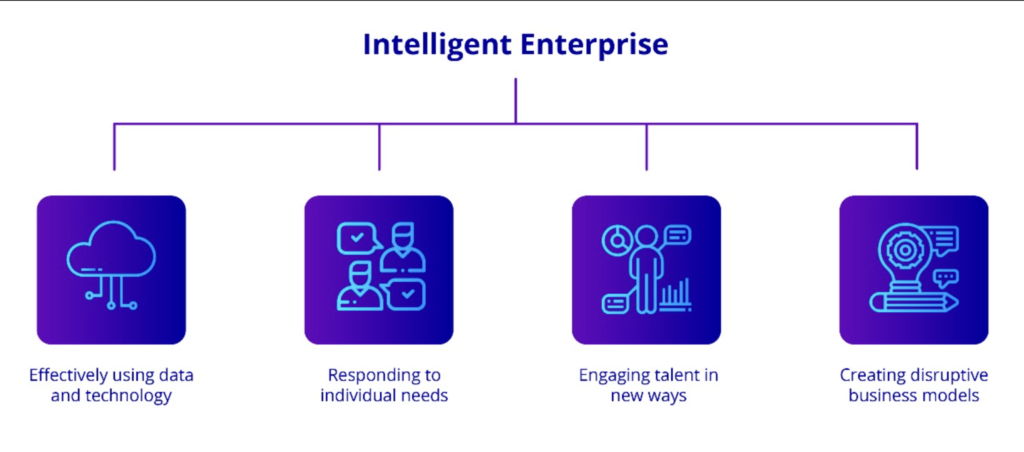
The most prosperous businesses in this new era are those that combine automation, human insight, and machine learning into a single dynamic ecosystem. The goal of an intelligent enterprise is to build an infrastructure that continuously learns, changes, and produces smarter outcomes at every operational level. It is not just about having access to AI.
Predictive Intelligence to Process Automation
For many years, companies saw technology as a way to cut expenses and automate processes. Intelligent businesses today go beyond automation to predictive intelligence, where artificial intelligence foresees problems before they happen.
Consider the logistics sector, where intelligent systems are now able to predict weather-related delays, optimize shipping routes, and automatically reallocate resources to ensure efficiency. AI in finance enables businesses to make proactive strategy adjustments by identifying market trends weeks before they become apparent. Organizations become predictive innovators as a result of this evolution, able to influence their future rather than just survive it.
Automating Processes with Predictive Intelligence
Businesses have long viewed technology as a means of automating procedures and reducing costs. Predictive intelligence, in which artificial intelligence anticipates issues before they arise, is the next step up from automation for intelligent businesses.
Take the logistics industry, where sophisticated systems can now anticipate delays caused by bad weather, optimize shipping routes, and automatically reallocate resources to guarantee efficiency. By spotting market trends weeks before they become noticeable, artificial intelligence (AI) in finance helps companies to make proactive strategy adjustments. As a result of this evolution, organizations become predictive innovators, able to shape their future instead of merely surviving it.
Continuous Learning: Building Adaptable Organizations
Business models that don’t change are becoming outdated. Continuous learning is essential to the intelligent enterprise, which uses AI to adapt to every new dataset, shift in the market, or interaction with customers.
AI systems used by tech giants like Microsoft and IBM track usage trends worldwide and automatically update performance algorithms without the need for human intervention. The business of the future not only adjusts to change, but also learns how to learn. Businesses can remain resilient in erratic markets thanks to this culture of adaptability. Organizations attain a state of continuous development and rejuvenation when data serves as the teacher and AI as the student.
Human Intelligence at the Center
The emergence of the intelligent enterprise redefines the value of people rather than replacing them, despite what many people fear. Human intuition, morality, and emotional intelligence are still invaluable, even though AI can handle complexity at scale.
Employees in intelligent organizations interpret AI insights, develop innovative strategies, and make moral decisions rather than wasting time on monotonous tasks. For instance, a marketing team may employ AI to assess sentiment around the world while depending on human ingenuity to develop impactful advertising campaigns. A new type of workforce that is both creative and analytical is produced by the combination of artificial and human intelligence.
The Cornerstone of Sustainable Growth is Responsible Intelligence.
Without accountability, intelligence can destroy just as easily as it can create. Because of this, contemporary businesses are concentrating on ethical AI governance, making sure that each algorithm is transparent, equitable, and accountable.
While healthcare organizations use AI explainability tools to ensure diagnostic fairness, banks are putting bias-auditing frameworks into place. Ethical intelligence is now seen as essential to sustainability by both businesses and governments. Companies that put a high priority on ethical AI not only protect their brand but also gain the long-term confidence of investors and customers.
Global Intelligence Networks: The Next Frontier of Collaboration
The intelligent enterprise’s next evolution is network-based and not specific to any one company. Businesses all over the world are partnering with AI to build collective intelligence ecosystems using shared data and insights.
Companies from different continents use connected AI systems in industries like renewable energy to optimize energy distribution worldwide and balance power grids. Southeast Asian startups work with European data companies to jointly create machine learning tools that spur innovation. Every link strengthens the global business fabric, resulting in exponential growth due to this shared intelligence.
References:
-
- “How AI Will Change Business Forever.” Harvard Business Review (2024). https://hbr.org/2024/03/how-ai-will-change-business-forever
- “How AI Will Change Business Forever.” Harvard Business Review (2024). https://hbr.org/2024/03/how-ai-will-change-business-forever
-
- “AI in Business: The Strategic Imperative.” Forbes (2025). https://www.forbes.com/sites/forbestechcouncil/2025/01/15/ai-in-business-the-strategic-imperative
- “AI in Business: The Strategic Imperative.” Forbes (2025). https://www.forbes.com/sites/forbestechcouncil/2025/01/15/ai-in-business-the-strategic-imperative
-
- “The State of AI in 2025.” McKinsey & Company (2025). https://www.mckinsey.com/business-functions/mckinsey-analytics/our-insights/state-of-ai-2025
- “The State of AI in 2025.” McKinsey & Company (2025). https://www.mckinsey.com/business-functions/mckinsey-analytics/our-insights/state-of-ai-2025
-
- “Global AI Race and Its Impact on Enterprises.” World Economic Forum (2025). https://www.weforum.org/agenda/2025/05/global-ai-race-impact-enterprises
- “Global AI Race and Its Impact on Enterprises.” World Economic Forum (2025). https://www.weforum.org/agenda/2025/05/global-ai-race-impact-enterprises
-
- “AI and Human Collaboration in the Enterprise.” MIT Sloan Management Review (2025). https://sloanreview.mit.edu/article/ai-and-human-collaboration-in-the-enterprise
- “AI and Human Collaboration in the Enterprise.” MIT Sloan Management Review (2025). https://sloanreview.mit.edu/article/ai-and-human-collaboration-in-the-enterprise
Disclaimer: This article was drafted with the assistance of AI technology and then critically reviewed and edited by a human author for accuracy, clarity, and tone.